
How Glass Fiber Liquid Filter Cartridges Improve Industrial Fluid Filtration
, بواسطة WANGZEYU, 8 دقيقة وقت القراءة
, بواسطة WANGZEYU, 8 دقيقة وقت القراءة
Industrial liquids such as coatings, inks, adhesives and process chemicals often contain fine particles, colloids, gels and oil-based contaminants. Removing these impurities effectively is essential for maintaining product quality, protecting downstream equipment and reducing production interruptions.
However, conventional filter cartridges may experience rapid blockage, rising pressure drop or insufficient retention when processing liquids with high particle loads. Glass fiber liquid filter cartridges provide an effective solution by combining fine filtration efficiency with a high contaminant-holding capacity.
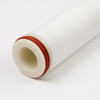
The FRERE FR-GF Glass Fiber Liquid Filtration Filter Cartridge Series is designed for demanding industrial applications where stable filtration performance and efficient particle removal are required.
A glass fiber liquid filter cartridge uses ultra-fine glass fibers as its primary filtration medium. The fibers form a dense, three-dimensional filtration structure capable of capturing fine particles throughout the depth of the filter media.
Unlike a simple surface filter, which retains most contaminants on its outer layer, a depth filtration cartridge allows particles to enter different layers of the filter medium. Larger contaminants are captured in the upstream layers, while smaller particles are retained deeper inside the cartridge.
This graded filtration mechanism helps the cartridge:
Capture fine and unevenly sized contaminants
Hold a larger quantity of particles
Reduce premature surface blockage
Maintain a more stable flow rate
Protect downstream precision filters
The FR-GF series uses ultra-fine glass fibers with controlled diameters ranging from approximately 0.5 to 2 μm. Through a multi-layer composite structure, the fibers are distributed uniformly to provide consistent filtration performance across the cartridge.
Glass fiber filtration media have several characteristics that make them particularly suitable for processing industrial liquids containing colloids, oils and fine suspended particles.
The small fiber diameter creates a dense filtration network with numerous particle-capture points. This allows the cartridge to remove fine contaminants that may pass through conventional coarse filter media.
The FR-GF series is available in filtration ratings from 0.2 to 5 μm, making it suitable for both fine prefiltration and selected high-efficiency filtration processes.
Industrial coatings, inks and adhesives often contain a combination of hard particles, soft particles, agglomerates and gels. These contaminants can quickly block cartridges with a uniform surface structure.
The multi-layer depth structure of a glass fiber cartridge distributes contaminants throughout the filter media instead of concentrating them on one surface. This improves dirt-holding capacity and can extend the cartridge’s effective operating life.
Pressure drop directly affects pump load, energy consumption and system stability.
The FR-GF cartridge is designed with an initial differential pressure as low as approximately 0.02 bar under suitable operating conditions. A lower initial pressure drop helps maintain the required flow rate while reducing unnecessary energy consumption.
As contaminants accumulate, operators should continue monitoring the differential pressure and replace the cartridge before the system reaches its recommended terminal pressure limit.
Uneven fiber distribution can create weak filtration areas, localized blockage or bypass risks. The FR-GF series uses a multi-layer composite manufacturing process to maintain consistent fiber distribution.
A uniform filtration structure helps reduce variations between different sections of the cartridge and supports more predictable performance during continuous production.
The FR-GF Glass Fiber Liquid Filtration Filter Cartridge Series offers the following characteristics:
Filtration ratings from 0.2 to 5 μm
Ultra-fine glass fiber filtration media
Controlled fiber diameter of approximately 0.5–2 μm
Filtration area of approximately 0.67–0.98 m² per 10-inch cartridge, depending on the selected rating
Maximum recommended temperature of up to 80°C
Maximum differential pressure of up to 4 bar at 21°C
Multi-layer depth filtration structure
Low initial pressure drop
High particle adsorption and contaminant-holding capacity
Integrity testing before shipment
Actual operating performance may vary according to liquid viscosity, temperature, flow rate, contaminant concentration, cartridge length, housing design and chemical compatibility.
Glass fiber liquid filter cartridges can be used in a wide range of industrial processes, particularly where liquids contain fine particles, colloidal contaminants or oil-based impurities.
Unwanted particles and agglomerates can affect coating uniformity, surface finish and application equipment. Glass fiber cartridges can be installed before filling, spraying or final processing to remove fine contamination.
Fine particles, gels and dried materials in printing inks may block nozzles or reduce printing consistency. An appropriately selected glass fiber cartridge helps improve ink cleanliness and protect downstream equipment.
Adhesives and resin-based liquids may contain gels, raw-material impurities and process contaminants. Depth filtration helps capture these materials while maintaining a stable production flow.
The FR-GF series may be used for compatible chemical solutions, process fluids and intermediate products that require fine particle control. Chemical compatibility should always be confirmed before cartridge selection.
One of the most important applications is the protection of downstream high-precision cartridges or membrane systems.
By removing a large portion of the contaminant load in advance, the FR-GF cartridge can reduce the burden on more expensive final filters. This can help extend downstream filter life, reduce replacement frequency and improve overall filtration economics.
Selecting a filter cartridge based only on micron rating may lead to unstable performance. Several operating conditions should be evaluated.
The selected micron rating should match the size of the contaminants that need to be removed and the cleanliness requirement of the final product.
A smaller micron rating does not automatically provide the most economical solution. Excessively fine filtration may increase pressure drop and shorten service life if the liquid contains a high concentration of large particles.
High-viscosity liquids create greater flow resistance than water-like fluids. The filtration area, cartridge quantity and operating flow rate may need to be adjusted for coatings, oils, resins and concentrated adhesives.
Hard particles, gels, colloids and oil-based contaminants behave differently inside the filter media. Understanding the main contaminant type helps determine whether glass fiber depth filtration is suitable for the application.
The cartridge materials must remain stable at the actual process temperature. The FR-GF series is designed for temperatures up to 80°C under appropriate conditions, but temperature limits may also depend on the end caps, seals, support materials and process liquid.
The cartridge should be sized to maintain an acceptable flow rate without excessive pressure loss. Systems with large flow requirements may require longer cartridges or multiple cartridges installed in a multi-round housing.
All cartridge components must be compatible with the process liquid. The filtration medium, support layers, core, end caps and sealing materials should be reviewed before use with solvents, acids, alkalis or other aggressive chemicals.
Correct operation is essential for obtaining stable filtration results and avoiding premature cartridge replacement.
Before installation, confirm that the cartridge dimensions, connector type, seal material and micron rating match the filter housing and process requirements.
Because glass fiber media may require initial wetting, the cartridge should be properly wetted or flushed with a compatible liquid before full operation. Flow should be introduced gradually to avoid sudden hydraulic shock.
During operation, monitor:
Inlet and outlet pressure
Differential pressure
Flow-rate changes
Product cleanliness
Filtration cycle length
Abnormal leakage or bypass
Cartridges should be replaced according to the validated terminal differential pressure, product-quality requirements or the plant’s preventive maintenance schedule.
The purchase price of a filter cartridge represents only one part of the total filtration cost.
A suitable cartridge can help reduce:
Unplanned production shutdowns
Downstream filter replacements
Product rejection and reprocessing
Pump energy consumption
Filter housing maintenance
Labor required for cartridge replacement
For liquids with high concentrations of colloids, oils or fine particles, a cartridge with a high contaminant-holding capacity may provide better long-term value than a lower-cost cartridge that blocks quickly.
The FR-GF series is designed to combine fine filtration, low initial pressure drop and strong contaminant retention, helping industrial users maintain stable filtration cycles and protect downstream equipment.
Every industrial filtration process has different requirements. Liquid composition, viscosity, particle size, temperature, flow rate and required product cleanliness should all be considered before selecting a cartridge.
FRERE supplies glass fiber liquid filter cartridges and other industrial filtration products for water treatment, chemical processing, coatings, inks, adhesives and related applications.
To receive a suitable cartridge recommendation, provide the following information:
Process liquid
Required filtration rating
Operating temperature
Flow rate
Working pressure
Liquid viscosity
Main contaminant type
Existing cartridge dimensions
Filter housing configuration
Current filtration problem
Based on these parameters, the FRERE team can recommend an appropriate cartridge specification, sample option or filtration solution for your system.